

Expert insights, proven strategies, and the latest trends to help you dominate social media and grow your online presence.

Telegram has evolved far beyond a simple messaging application. Today it functions as a discovery platform where users search for communities, bots, tools, and content directly inside the app.
Millions of searches happen on Telegram every day. Users search for trading channels, crypto news, marketing communities, automation bots, educational groups, and many other niche topics.
Telegram has evolved far beyond a simple messaging application. Today it functions as a discovery platform where users search for communities, bots, tools, and content directly inside the app.
Millions of searches happen on Telegram every day. Users search for trading channels, crypto news, marketing communities, automation bots, educational groups, and many other niche topics.

Imagine this scenario.
You create a Telegram channel with great
content. You post regularly, invite some friends, and expect people to discover
it through Telegram search.
But when you search for your channel name inside
Telegram… nothing appears.
Meanwhile, other channels with fewer posts and
lower quality content appear at the top of the search results.
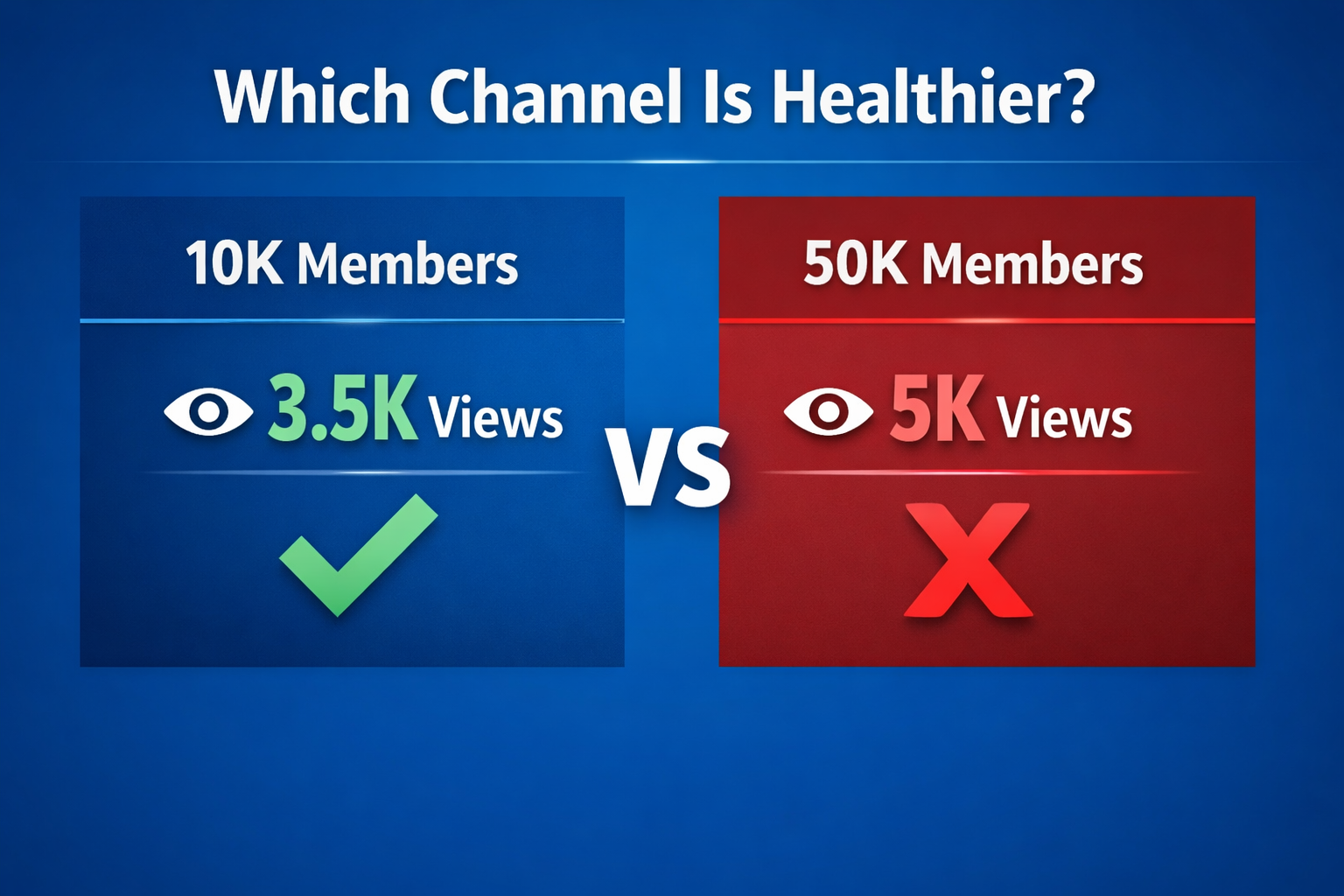
Telegram View Rate and Engagement Rate measure different parts of channel performance. View Rate compares visible post views with subscriber count, while an engagement or interaction rate compares defined actions—such as reactions or forwards—with a clearly stated denominator such as views or subscribers.
A channel can have a high View Rate and relatively little interaction. It can also have a lower View Rate while the people who do see its posts interact at a relatively higher rate.
That is why the two percentages should not be treated as interchangeable.
Telegram also does not publish one universal official “Engagement Rate” formula. If you calculate an engagement percentage, you need to define exactly which interactions are included and what denominator is being used.
Neither metric alone proves audience quality, account authenticity, trust, conversion, or Telegram ranking.
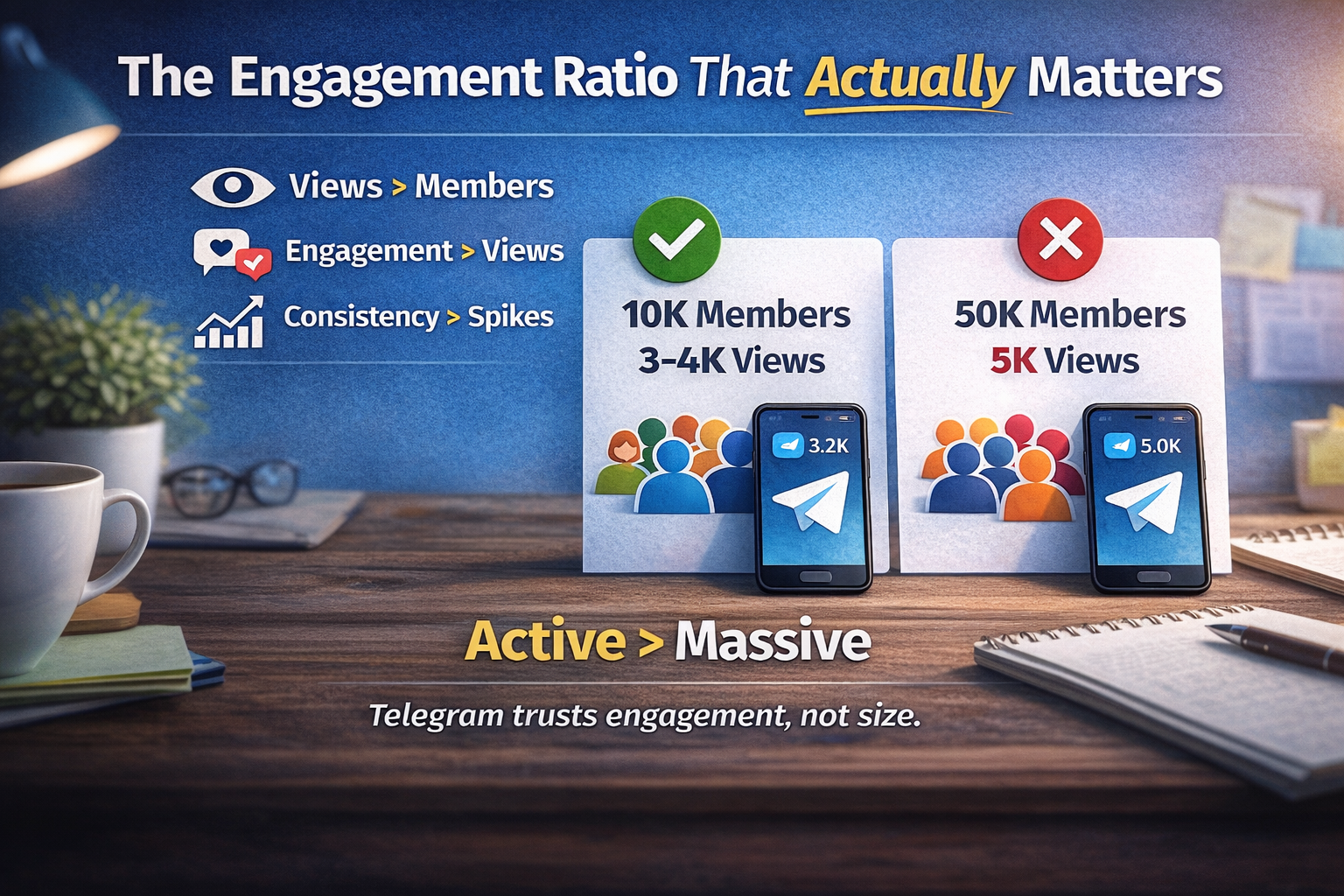
Many Telegram channel owners focus on one thing only: growing numbers.
More members. Bigger channels. Higher screenshots.
But here’s the uncomfortable truth 👇
Big numbers don’t mean healthy growth.
Telegram doesn’t reward size —
it rewards activity, consistency, and engagement.
This is where the engagement ratio becomes the most important metric you should care about.
In this article, we’ll explain:
what engagement ratio really means on Telegram
what a “good” ratio looks like
why smaller channels often outperform bigger ones
and how Telegram uses engagement to decide visibility
No myths. No shortcuts. Just how it actually works

In today’s competitive digital environment, user trust is one of the most valuable assets any online brand, community, or creator can have. On Telegram, where thousands of channels and groups compete for attention, trust often determines whether a user stays, engages, or leaves within seconds.
Telegram Premium, while commonly known for its advanced features, plays a deeper and more strategic role than many realize. Beyond larger uploads and exclusive tools, it has become a powerful trust signal that influences how users perceive accounts, channels, and services on the platform.
This article explores how Telegram Premium impacts user trust and why it matters for sustainable growth

Telegram ads can be highly effective — but only with the right strategy.
Many channel owners and businesses spend money on Telegram advertising expecting quick results, only to end up disappointed. In most cases, the problem isn't Telegram ads themselves, but launching campaigns without proper planning.
Telegram advertising is not a one-size-fits-all solution. Different goals, audiences, and channels require different approaches. Before spending your budget, it's essential to understand whether your channel is ready, who you're targeting, and what results you can realistically expect.
This guide walks you through five critical questions you must answer before running Telegram ads, helping you avoid common mistakes and build campaigns that deliver real results

Introduction
Starting a new Telegram channel is exciting, but many admins quickly face restrictions. These issues usually stem from rapid member spikes, low engagement, or using fake member services. This article highlights common mistakes and safe growth strategies, helping you gradually build an active and credible community while avoiding bans.

Telegram Views are the counts displayed next to channel posts to show how many times a post has been viewed. However, the number should not be interpreted as an exact count of unique subscribers or individual people.
Telegram explains in its official Channels FAQ that views from forwarded copies are included in the total view count. Telegram also describes these counters as approximate and notes that, after a short period of around four days, viewing the same post again may be counted again.
That means Telegram post views are useful for measuring exposure, but they need context. To interpret them correctly, you should look at subscriber count, forwards, reactions, post age, View Rate, and—when relevant—clicks and conversions alongside the raw view number.
Telegram Views are the numbers shown next to posts published in a Telegram channel.
They indicate post exposure, but they are different from other channel metrics such as:
Subscribers
Reactions
Comments
Forwards
For example, a channel could have:
10,000 subscribers
3,000 post views
80 reactions
25 forwards
Each number answers a different question.
Subscribers describe the current audience size.
Views describe approximate post exposure.
Reactions show visible reaction actions.
Forwards show how many times a post has been forwarded.
Looking at these separately makes channel analysis much clearer. For a broader measurement framework, see the Telegram metrics that actually matter.
Each Telegram channel post has a visible view counter.
According to Telegram's official Channels FAQ, the counter includes views from both the original post and forwarded copies of that message.
Telegram also describes the count as approximate rather than a permanent record of every unique person who has ever seen a post.
One important detail is repeat viewing.
Telegram says that after a short period—around four days—it may forget that a person has already viewed a post. If that person later returns to the same message, another view may be counted.
This means the visible counter should not be interpreted as:
One view per IP address
One view per device forever
One view per Telegram account forever
A 24-hour unique-user metric
Telegram does not define the visible channel counter using those rules.
The safest interpretation is:
Telegram View Count = approximate post exposure, including eligible forwarded and repeat views.
No. Telegram's visible view counter should not be treated as an exact unique-user count.
There are three main reasons.
First, Telegram states that views from forwarded copies contribute to the total.
Second, Telegram describes the counter as approximate.
Third, repeat viewing can eventually contribute another count after Telegram no longer remembers the earlier view.
Therefore, a post showing 5,000 views does not necessarily mean exactly 5,000 different Telegram users viewed it.
This distinction matters when comparing views with subscriber count or calculating reach-related ratios.
Telegram Views are useful, but they are not the same as an analytics platform reporting verified unique users.
Yes.
Telegram explicitly states that views from forwarded copies of channel messages are included in the total view count.
This means a post can continue accumulating exposure after it leaves the original channel.
For example:
Original channel subscribers: 5,000
Post views: 6,500
That does not necessarily mean 130% of the channel's subscribers viewed the post.
Some of those views may have come from forwarded copies or wider distribution beyond the original subscriber base.
This is one reason Telegram Views should be interpreted as an exposure metric rather than an exact subscriber-reach count.
Yes.
A Telegram post can receive more views than the channel has subscribers.
Suppose a channel has:
10,000 subscribers
13,500 post views
Using the basic View Rate formula:
13,500 ÷ 10,000 × 100 = 135%
Mathematically, the View Rate is 135%.
But this does not mean 135% of subscribers uniquely viewed the post.
Forwarding and distribution outside the existing subscriber base can increase the view counter beyond the channel's subscriber total.
This is why unusually high View Rates need context.
If you want to compare View Rate with channels of a similar size, use Telegram engagement rate benchmarks rather than assuming that views divided by subscribers always represents unique subscriber reach.
Views and subscriber count measure different things.
| Metric | What It Tells You | What It Does Not Prove |
|---|---|---|
| Subscribers | Current channel audience size | How many people viewed a specific post |
| Views | Approximate post exposure | Exact unique subscriber reach |
| Reactions | Visible reaction actions | Overall audience sentiment or conversion |
| Forwards | Number of forwards | Guaranteed growth or ranking |
A channel can gain subscribers without its average views increasing at the same rate.
It can also receive strong views on a particular post without gaining many new subscribers.
For that reason, neither subscriber count nor view count should be used alone to describe total channel performance.
Views primarily describe exposure.
Reactions, comments, and forwards describe different forms of interaction.
Consider two posts:
Post A
10,000 views
50 interactions
Post B
4,000 views
200 interactions
Post A recorded more views according to the view counter.
Post B generated more interaction relative to its view count.
Without knowing the campaign objective, it would be misleading to declare one universally “better.”
A high Telegram view count does not automatically prove:
Strong engagement
Audience trust
Credibility
Conversion
Customer intent
Views tell you how much exposure a post recorded. Other metrics are needed to understand what happened after that exposure.
View Rate compares average post views with subscriber count.
The formula is:
View Rate = Average Post Views ÷ Subscribers × 100
Example:
Subscribers: 20,000
Average post views: 4,000
Calculation:
4,000 ÷ 20,000 × 100 = 20%
The channel has a 20% View Rate using this formula.
View Rate is useful for comparing channels or tracking changes over time, but it requires one important disclaimer:
View Rate should not be interpreted as the exact percentage of subscribers who saw the post.
Telegram's visible view count may include forwarded views and, under certain conditions, repeat views.
Use View Rate as a comparative exposure ratio, not as an exact unique-subscriber measurement.
Telegram posts do not all receive the same number of views.
Several factors can affect exposure, including:
Post age
Content relevance
Publishing frequency
Sharing and forwarding
External distribution
Audience activity
Topic
Publication timing
For example, an older post has had more time to accumulate views than a post published 20 minutes ago.
A heavily forwarded post can also receive additional exposure outside the original channel.
Publishing time may influence how quickly the existing audience encounters a post. If you want to investigate that variable separately, see how Telegram posting time can affect early views and engagement patterns.
These factors do not require an assumption that Telegram's algorithm “rewards” a particular behavior.
They are simply variables worth controlling when comparing post performance.
Telegram Views are useful for several practical types of analysis.
You can use them to:
Compare exposure between similar posts
Track average views per post over time
Identify changes in content performance
Calculate View Rate
Compare content formats
Evaluate distribution alongside forwards
Monitor whether reach is increasing or declining
Telegram's official Channel Statistics also include metrics such as average views per post and shares per post for eligible channels.
However, View Count alone should not be used to prove:
Audience authenticity
Audience quality
Trust
Sales
Conversion
Search ranking
Those are different questions that require additional data.
Audience-driven or naturally occurring views may result from subscriber exposure, forwarding, external sharing, and other forms of distribution.
A delivered view service provides a defined number of views according to the specifications of that service.
These should be measured separately.
If you use a Telegram post views and shares service, evaluate the delivered views according to the service specifications and track audience-driven views, reactions, clicks, and conversions separately.
The important distinction is not to make unsupported assumptions about quality, safety, ranking, or authenticity based only on the source label.
Instead, measure what was delivered and then evaluate broader channel performance independently.
Delivered views change the view count associated with the service.
They should not automatically be treated as evidence of:
Higher organic engagement
Better Telegram search ranking
Higher CTR
More conversions
Better subscriber retention
Increased organic reach
For example, if a post receives additional delivered views but its reactions remain unchanged, those are two separate observations.
Likewise, a change in the visible view count does not establish that more people clicked a website link or completed a purchase.
Paid or delivered metrics should therefore be evaluated according to the specific service being used, while organic interaction and business results should be measured separately.
Never evaluate one metric in isolation.
When reviewing Telegram post views, look at several signals together:
Average views across multiple posts
Subscriber count
View Rate
Reactions
Forwards
Post age
Traffic source when available
CTR when posts contain tracked links
Conversion Rate when Telegram supports a business goal
For example, a rise in average views becomes easier to interpret if you also know whether:
Subscriber count increased
Forwarding increased
Posting frequency changed
Reactions changed
Website clicks changed
A multi-metric view reduces the risk of making conclusions from one number.
A consistent reporting period makes trends easier to understand.
For example:
| Metric | Current 30 Days | Previous 30 Days | Change |
|---|---|---|---|
| Average Views/Post | 3,200 | 2,900 | +10.3% |
| Subscribers | 20,500 | 20,000 | +2.5% |
| View Rate | 15.6% | 14.5% | +1.1 pp |
| Avg. Reactions/Post | 85 | 78 | +9.0% |
| Avg. Forwards/Post | 24 | 20 | +20.0% |
These numbers are illustrative examples, not Telegram benchmarks.
This type of comparison is more useful than reacting to each post individually.
For a fair comparison, keep the measurement period and calculations consistent.
If your current period includes seven days of post exposure but your previous period includes 30 days, the comparison can become misleading.
Telegram Views are not an exact unique-user counter.
Forwarded views and later repeat viewing can contribute to the total.
Post age affects how long a message has had to accumulate exposure.
Compare posts at similar ages when possible.
One widely forwarded post can make overall performance appear stronger than the normal pattern.
Use averages across multiple posts.
Raw views need context.
3,000 views on a 4,000-subscriber channel and 3,000 views on a 100,000-subscriber channel describe very different ratios.
Views measure exposure.
They do not automatically show reactions, comments, clicks, conversions, or retention.
When a delivered view service is used, evaluate those views separately from naturally occurring audience activity.
Do not assume one automatically represents the other.
There is no universal number of Telegram views that is good for every channel.
Raw view count becomes useful only when you add context.
For example, 3,000 views could represent very different performance depending on whether the channel has:
4,000 subscribers
20,000 subscribers
100,000 subscribers
Post age, forwarding, content type, and audience behavior also affect interpretation.
A better approach is to calculate View Rate, compare similar-size channels, and monitor your own average views over consistent periods.
The trend is often more actionable than one standalone number.
Telegram channel posts have a view counter that updates as posts are viewed. Telegram states that views from forwarded copies are also included and describes the counter as approximate.
No. The visible view counter should not be treated as an exact unique-user count.
Yes. Telegram explicitly states that views from forwarded copies of channel messages contribute to the total view count.
Yes. Forwarding and distribution beyond the original subscriber base can result in more views than subscribers.
Telegram says its counters are approximate and that after a short period—around four days—it may forget that a person viewed a post and count a later visit again.
There is no universal number. View count should be interpreted relative to channel size, post age, content type, distribution, and historical performance.
View Rate compares average post views with subscriber count:
Average Post Views ÷ Subscribers × 100
It is useful for comparison but should not be interpreted as exact unique subscriber reach.
Not necessarily. Views indicate exposure, while engagement involves separate actions such as reactions, comments, and forwards.
Telegram does not publish documentation establishing that a higher post view count guarantees better search ranking.
View services are available, but they should be evaluated based on their published service specifications rather than assumed effects on organic engagement or ranking.
Telegram Views are a useful measure of post exposure, but the visible counter is not an exact unique-subscriber metric.
Forwarded copies contribute to total views, Telegram describes its counters as approximate, and repeat viewing can eventually be counted again.
For useful analysis, compare similar posts over consistent periods and look beyond the raw number. Subscriber count, View Rate, reactions, forwards, post age, and relevant business metrics all provide additional context.
The most useful approach is to treat Telegram Views as one part of a wider measurement system—not as proof of engagement, audience quality, ranking, or conversion.

The difference between fake and real Telegram members is not as simple as checking views, profile photos, reactions, or whether a subscriber stays in a channel.
A real Telegram account does not automatically mean an engaged, loyal, or converting member. Likewise, low engagement or a sudden change in subscriber count does not prove that accounts are fake.
The most useful way to evaluate Telegram members is to separate three different questions: what can be established about the account, how the member was acquired, and what the member does after joining.
These are not interchangeable:
Real account ≠ engaged member ≠ voluntary acquisition ≠ retained member
Once these concepts are separated, channel metrics become easier to interpret without assigning conclusions that the available data cannot actually prove.

Choosing a Telegram growth service can be tricky. With many providers offering fast results, users often overlook an essential factor: refund policies and safe service guarantees.
In this guide, we explain why a clear refund policy matters, how it reflects the credibility of a service, and what to look for when choosing a Telegram SMM panel